
Our People
Get a glimpse into some of the careers at EDF power solutions!
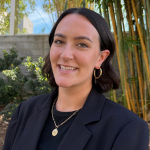

Given that her father is an engineer and her mother a math teacher, it may not be much of a surprise that Frances Palmer loved calculus and science classes in high school. Growing up in a suburb outside Boston, music was a big part of her life. She played in a band with her brother and three friends and regularly went into the city on weeknights to see shows, which her parents condoned as long as her grades stayed strong. She gravitated toward indie rock – bands like The Kooks and Portugal. The Man – and traveled with friends to music festivals in Montreal and Delaware.
By her senior year of high school, Frances had developed a strong interest in environmental science and sustainability, settling on civil and environmental engineering as a practical way to combine those interests and work toward solutions. She chose the University of Wisconsin-Madison for her studies. “I wanted the full college experience – football games, dorm parties, all of it,” she recalls. Alongside her major, she added minors in energy systems and sustainability, steadily narrowing her focus toward renewable energy.
During college, Frances interned for three years at Madison Gas & Electric in the energy technology department. She worked on solar and wind data analysis and visited a wind site under construction in rural Iowa where she saw turbine foundations being built from the ground up. The scale and complexity of the projects made a lasting impression.
“I can’t think of a better place to have worked,” she reflects. “My first boss taught me about the fundamentals of the electrical grid, and my second boss worked on the electric vehicle charging program.” Way back in 2018, Frances was already helping coordinate EV charger installations for customers – a technology that’s become the focus of her job today.
By the junior year of her undergraduate degree, Frances knew she wanted to pursue a master’s degree focused on renewable energy. She submitted 14 applications and landed in Stanford University’s program on Atmospheric Science and Energy Systems. She was particularly drawn to the research of Mark Jacobson on large-scale renewable systems, and he ultimately became her advisor and mentor.
Frances put herself through graduate school with paid internships and teaching assistantships and also held an unpaid position as a research assistant. As an intern at the Electric Power Research Institute, she analyzed battery energy storage deployments across the US, gaining exposure to the growing role of storage on the grid. A subsequent internship with EDF power solutions brought her closer to commercial applications of battery modeling and grid-edge solutions.
Upon graduation, Frances wanted to stay in the Bay Area and worked briefly at Stem, Inc. where she focused on e-mobility and the intersection of batteries and EV charging. Although the role didn’t work out, the experience helped clarify that she wanted to be closer to customers and implementation rather than purely analytical or research-focused work – and it also positioned her to segue into her current role at PowerFlex.
After joining PowerFlex’s EV Charging Solutions team in 2023, her first few months were focused on deployments at airports. However, it was becoming clear that customers were seeking more structured, ongoing support on a regular basis. “The sales team was spending significant time managing existing accounts, which limited their ability to pursue new opportunities. It was decided that we needed an account manager to provide customer support.”
Frances became a team of one and served as the first dedicated account manager for the EV charging side of the business for a year, during which time she demonstrated the value of this role. Her team has since expanded to include two direct reports, and she’s in the process of adding a third. “I started by taking on three or four key clients and serving as a resource for their ongoing, day-to-day needs. Today we manage 15 accounts.”
Delivering customer satisfaction is central to her role. Internally, she coordinates with colleagues on new product releases and program updates, with the goal of delivering a seamless user experience. Externally, customer support might take the form of “driver days,” events at which representatives from the client and PowerFlex meet face-to-face with EV drivers. “We help them understand how to use the PowerFlex app and the chargers, educate them about how our Adaptive Load Management software works, and try to ensure that everything goes smoothly,” Frances explains.
In reflecting on her role, Frances notes that although she no longer practices traditional engineering design, she nevertheless draws on a core principle she learned while studying for her undergraduate degree: “No problem is unsolvable. Even the most complex challenge can be broken down into manageable pieces.”
“I find myself using my graduate degree almost every day. Customers recognize that I understand the broader electrical system and see me as a partner who’s working to solve their problems, not just someone trying to sell them something.”
And while she may not use her engineering skills much these days, “I find myself using my graduate degree all the time.” When troubleshooting with clients, she draws on her knowledge of renewable energy, electricity markets, and grid constraints. “Customers recognize that I understand the broader electrical system and see me as a partner who’s working to solve their problems, not just someone trying to sell them something.”
When she’s not making each client feel like they’re the company’s most important customer, you might find Frances training for her next marathon. “I never used to like running, but after I moved to San Diego, I started running with friends. I’ve now run four half-marathons and one full marathon – and this July I’ll be running the San Francisco Marathon.”
“As EV adoption accelerates, the need for reliable, well-managed charging infrastructure will only increase. The future belongs to solutions that are resilient, adaptable, and thoughtfully integrated with the grid, and I’m proud to contribute to that mission.”
Looking ahead, Frances is enthusiastic about helping PowerFlex expand its EV charging footprint nationwide. “As EV adoption accelerates, the need for reliable, well-managed charging infrastructure will only increase,” she says. “The challenge is bigger than just installing chargers – it’s managing them intelligently. The future belongs to solutions that are resilient, adaptable, and thoughtfully integrated with the grid, and I’m proud to contribute to that mission.”